THANK YOU FOR SUBSCRIBING
× 
Enterprise Security Mag Weekly Brief
Be first to read the latest tech news, Industry Leader's Insights, and CIO interviews of medium and large enterprises exclusively from Enterprise Security Mag
Enterprise Security Magazine

TSplus
Protecting the Applications That Keep Business Running

 Dominique Benoit, CEO
At a small scale, this burden may be manageable. But across hundreds or thousands of users, it can quickly become a constraint on growth. Software versions start to diverge, updates must be rolled out repeatedly, and support teams are left troubleshooting applications across devices and locations they do not directly control.
TSplus prevents that complexity from multiplying.
Its Remote Access software enables Windows applications to run from a central server or cloud environment while authorised users access them remotely. Rather than maintaining separate installations for each user, an organisation can manage the application from a single point and extend access wherever needed.
SpaSalon.com, a U.S. software provider serving approximately 50,000 beauty salons, illustrates the difference. Its application manages appointments, accounting, and other daily operations. Installing it at every location would have required thousands of separate deployments and repeated updates across its customer base. With TSplus Remote Access, SpaSalon.com hosted the application centrally and made it available to salons remotely. Updates could be applied once within the hosted environment, allowing the company to expand access without a corresponding increase in installation and maintenance work.
Seven years later, SpaSalon.com continues to rely on TSplus.
Whether it is a hotel managing reservations, a transportation company coordinating deliveries, or a manufacturer running plant operations, TSplus keeps the applications behind these critical functions accessible to authorised users, while maintaining the control and consistency that businesses depend on.
“One installation can serve 500 concurrent users. That is the value of keeping the application centralised,” says Dominique Benoit, CEO.
Layered Protection Without Added Complexity
Centralising an application simplifies delivery and maintenance, but it also makes protecting the underlying server all the more critical. TSplus Advanced Security grew from that very requirement. TSplus developed the product to safeguard application servers and Remote Desktop connections as Remote Access adoption expanded.
“When you access an application remotely, you must care about security. It’s not an option,” says Benoit.
The software implements several layers of protection around the server. Brute-force protection detects repeated failed login attempts and blocks suspicious IP addresses. Geographic controls restrict connections based on location, while working-hour restrictions define when users can access the environment. Ransomware protection monitors for malicious behaviour and can respond automatically when a potential attack is detected.

One installation can serve 500 users. That is the value of keeping the application centralised.

Simplicity remains central to how these protections are applied. Benoit points to geographic protection as a prime example: an administrator can select which countries should be allowed to connect, effectively closing access from regions where the business does not expect any users.
Approximately 80,000 servers are now protected by Advanced Security, which TSplus cites as evidence of its field-proven performance.
Three Users or Thousands
Benoit does not believe that the quality of a solution should depend on the size of the customer.
“The problem of cybersecurity is exactly the same, whether you are a small entity or a large corporation,” says Benoit.
TSplus has built its broader suite around that principle. Remote Access delivers Windows applications; Advanced Security protects the servers behind those connections; Remote Support enables technical assistance; and Server Monitoring provides visibility into server and website performance. More than 500,000 companies now use TSplus software worldwide.
Keeping the technology affordable makes the model accessible to organisations with varying resources. TSplus offers perpetual and subscription licensing, and reports average cost savings of 80 % compared with traditional remote access solutions. Smaller businesses can gain the capabilities they need without enterprise-scale budgets, while larger organisations can expand access as their user requirements grow.
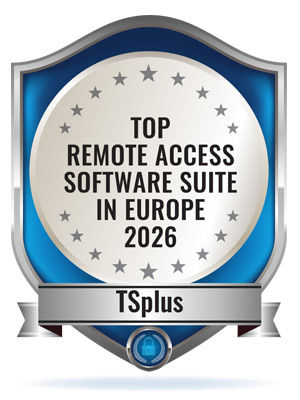
By centralising application delivery and protecting the infrastructure behind it, TSplus keeps essential software accessible as organisations and technology evolve. This approach earns TSplus recognition as Enterprise Security Magazine Europe’s Top Remote Access Software Suite in Europe 2026.
Remote Access Built around Application Control
A remote connection can turn a single compromised credential into direct access to the software that runs billing, scheduling, production or customer service. The purchasing decision, therefore, extends beyond whether employees can log in from another location. Executives must judge how the software controls entry to application servers and whether the delivery model fits the economics of the business.
Access architecture deserves scrutiny. Some platforms expose full desktops when a user needs only one business application, creating a broader attack surface and more support work than necessary. Application publishing can narrow that exposure while allowing a centrally hosted programme to reach distributed users. Browser access also matters where contractors or employees use mixed devices and cannot install a dedicated client. A practical suite should give IT teams control over what is published and how each user connects without forcing a redesign of the underlying Windows environment. It should also preserve familiar application behaviour, since remote access loses value when latency or awkward navigation pushes staff back toward local workarounds.
Security cannot sit beside remote access as a loosely connected product. Internet-facing servers attract repeated login attempts, stolen credentials, automated scans and traffic from locations where the company has no legitimate users. Controls such as geographic restrictions and automated blocking can reduce unnecessary exposure before an attacker reaches the application. Simplicity is part of the security test. A policy that requires specialist knowledge for every adjustment will be applied unevenly, particularly across smaller IT teams or distributed server estates. Buyers should test whether common restrictions can be configured quickly and understood without relying on outside specialists.
“TSplus software-led deployment model supports direct testing before purchase, while geographic access controls provide a clear way to restrict avoidable connection attempts.”
Management burden becomes more visible after deployment. Centralising an application can replace repeated workstation installations and make updates easier to govern, but the advantage disappears if administrators lack clear server health information or must switch among unrelated consoles. Monitoring should help teams identify performance issues before users report them. Remote support should also fit the same working model, giving technicians a direct way to assist users without adding a separate access stack. Clear alerts and usable reporting matter more than a large volume of raw telemetry.
Commercial structure can be just as important as technical fit. Per-user pricing may look manageable during a pilot and become difficult to defend as adoption expands. Buyers should compare perpetual and subscription options, support terms, renewal conditions and the cost of adding security later. Trial access is useful because it exposes installation effort and day-to-day administration before a broader commitment. The strongest evaluation is not a feature checklist but a controlled test using the company’s own applications and server policies.
TSplus is a strong choice for organisations that want remote application delivery without separating access, protection, support and administration into unrelated purchases. The wider TSplus suite combines Remote Access for Windows application publishing with Advanced Security for server protection. Its Remote Support and Server Monitoring extend the same environment into user assistance and infrastructure oversight. Its software-led deployment model supports direct testing before purchase, while geographic access controls provide a clear way to restrict avoidable connection attempts. For buyers prioritising application access and manageable server security under firm cost limits, TSplus merits serious consideration.
...Read more
Remote Access Software Suites in Europe Info
Q1
What Is a Remote Access Software Suite?
A Remote Access Software Suite brings together tools that let users reach desktops, applications, servers and related resources from another location. These offerings can cover application delivery, remote desktop access, printing, support, security and server monitoring rather than treating connectivity as a single function. For organizations managing distributed work or remote IT environments, the useful measure is how well these capabilities work together, how access is administered and whether the system can support existing applications and infrastructure.
Q2
What Does a Remote Access Software Suite Typically Include?
A Remote Access Software Suite can include browser-based application publishing, remote desktop connections, remote assistance, screen sharing, security controls and monitoring. The scope varies by provider, so evaluation should focus on the functions required in the actual environment. TSplus, for example, combines remote access with separate tools for remote support, Windows server security and server monitoring. Its platform also supports use cases involving ERP systems, SAP, software development and several industry environments, giving organizations options beyond basic desktop connectivity.
Q3
How Does TSplus Apply Remote Access Capabilities?
TSplus approaches the category through a family of products covering remote access, remote support, cybersecurity and monitoring. Its Remote Access product provides desktop access, application delivery and remote printing, while its Remote Support software supports attended and unattended assistance across Windows and macOS. The company also offers Advanced Security for Windows servers and Server Monitoring for real-time health tracking and alerts. Together, these documented capabilities show how a Remote Access Software Suite can extend from user access into support and infrastructure management.
Q4
What Should Organizations Evaluate Before Choosing One?
A Remote Access Software Suite should be assessed against application compatibility, deployment requirements, security controls, administration and performance. Browser access may simplify user connectivity, but the underlying platform still needs to work with applications and server environments already in place. Organizations should also examine how permissions are managed, what monitoring and reporting are available, how sessions perform across network conditions and whether the licensing model fits expected usage. These factors help distinguish a practical platform from one that only addresses basic remote connectivity.
Q5
How Can This Technology Support IT Teams?
Remote access technology can reduce the need for users and IT personnel to be physically present at a workstation or server. Remote assistance can help technicians access computers without being onsite, while monitoring tools can surface server or website issues in real time. Security functions can add controls around Windows server infrastructure. For IT teams, the value lies in bringing access, support, protection and visibility into a connected set of tools that can be managed according to the organization’s technical requirements.
Q6
What Role Does Scalability Play in Remote Access Software Suite Selection?
Scalability matters when access requirements expand across users, applications, devices or servers. A Remote Access Software Suite should accommodate changing workloads without forcing organizations to replace core systems whenever requirements grow. TSplus states that its software is used by more than 500,000 companies and supports large-scale environments; one customer example describes use across 10 servers with more than 550 simultaneous logins. Such documented use cases illustrate why capacity, deployment flexibility and administration should be considered alongside the feature list when evaluating a Remote Access Software Suite.
Company
TSplus
Management
Dominique Benoit, CEO
Description
TSplus provides a remote-access software suite that enables organisations to remotely access, protect, support, and monitor mission-critical Windows applications and the infrastructure behind them. Designed for businesses of all sizes, its products combine centralised Application Delivery with Server Security, Remote Support, and infrastructure monitoring.