
THANK YOU FOR SUBSCRIBING
× 
Enterprise Security Mag Weekly Brief
Be first to read the latest tech news, Industry Leader's Insights, and CIO interviews of medium and large enterprises exclusively from Enterprise Security Mag
Enterprise Security Magazine

Password Free
Breaking the Password Before It Breaks Everything

 Eusebio Coterillo, Co-Founder
Eusebio Coterillo, co-founder of Identit©® and creator of Password-free-2026©, describes this challenge clearly:
“Trust has become the most valuable currency in business. Every digital interaction, from banking transactions to enterprise logins, now depends on proving identity in an environment where attackers are no longer targeting systems directly, but the humans who use them.”
For decades, passwords served as the primary method of authentication, protecting everything from corporate networks and healthcare systems to financial platforms and personal accounts. But today's digital landscape is fundamentally different. Organizations now operate across cloud environments, mobile platforms, and interconnected ecosystems where traditional security boundaries no longer exist. At the same time, cybercriminals increasingly rely on phishing, credential theft, social engineering, and AI-powered impersonation techniques that exploit users rather than technical infrastructure.
This exposes a fundamental weakness in traditional authentication. Users are required to prove who they are to a service, but the service does not always prove that it is legitimate to the user. We have spent decades asking, “Are you really who you claim to be?” Far less attention has been paid to the equally important question the user should be able to ask: “Is this really the service I intended to reach?” That gap creates opportunities for attackers to impersonate trusted platforms and manipulate users into revealing sensitive information.
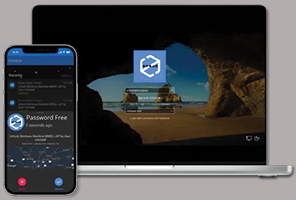 PasswordFree© was created to address this challenge by rethinking authentication itself. Instead of strengthening passwords or building additional layers around them, the company eliminates passwords altogether, replacing them with a system based on mutual verification between the user and the service. The result is Full Duplex Authentication®, a patented approach designed to eliminate password dependency while establishing trust in both directions.
Moving Beyond One-Way Authentication
Traditional authentication systems operate through a simple exchange: a service requests proof of identity, and the user provides credentials. Whether that credential is a password, a one-time passcode, or another authentication factor, the burden remains primarily on the user.
PasswordFree© changes this model with its unique two-way authentication process. Through Full Duplex Authentication®, both the user and the service verify each other before access is granted. This creates a stronger security model because a malicious website or impersonated service cannot simply rely on the user's willingness to provide a credential. The service itself must participate in the mutual authentication process.
”we are eliminating passwords entirely and creating a more secure foundation for digital trust.”
The technology uses encrypted communication between the authentication service and the user's registered device. During authentication, the service generates a dynamic image and numeric code, which are securely replicated on the user's device. The user confirms that both match before completing biometric verification through fingerprint or facial recognition.
As Coterillo explains:
“We improve security while simplifying the user experience. Security and usability should not be competing objectives. The best security is often the security people barely notice.”
While simplicity is an important benefit, the company's primary objective is security. By replacing static credentials with dynamic, mutual verification, PasswordFree© aims to reduce exposure to phishing attacks, credential theft, and fraudulent access attempts. The result is an authentication framework designed for a world where identity, not infrastructure, is the new security perimeter.
Full Duplex Authentication® As A Structural Shift
PasswordFree© views Full Duplex Authentication® not simply as another authentication factor, but as a fundamentally different security model. Rather than relying on a user to prove their identity through static credentials, the platform establishes trust through mutual verification between the user and the service.
The distinction is important. Adding another factor can strengthen authentication, but it does not necessarily change the underlying trust model. Full Duplex Authentication® is designed to change that model by making trust reciprocal.
By reducing authentication to a minimal interaction, PasswordFree© aims to transform login from a barrier into a seamless transition point. The goal is not simply to eliminate passwords. It is to eliminate unnecessary friction without sacrificing trust.
This shift changes authentication from a single login event into the beginning of a trusted digital relationship. By requiring both parties to validate one another before access is granted, the platform is designed to reduce the effectiveness of phishing attacks, man-in-the-browser attacks, rogue proxy interception, impersonation attacks, and other techniques that exploit one-way authentication models.
How The Experience Works In Practice
From the user's perspective, the experience is intentionally simple. Instead of entering a password, the user interacts with a secure prompt delivered to their registered device. This may involve scanning a QR code, responding to a push notification, or verifying a dynamic visual challenge.
The authentication server generates a unique visual and numeric combination that is mirrored on the user's device. The user confirms the match using biometrics such as facial recognition or fingerprint authentication, depending on the device.
This process removes password entry entirely while maintaining a high level of security assurance. The objective is straightforward: make authentication extraordinarily difficult to counterfeit without making it difficult for legitimate users.
In more advanced configurations, users can choose between single-device and dual-device authentication, with the latter adding an additional layer of separation between login initiation and approval. This reduces the risk of accidental approvals and strengthens resistance against push fatigue attacks.
Loginfree and The Removal Of Returning Friction
Beyond initial authentication, PasswordFree© introduces LoginFree, a feature designed to eliminate repetitive login steps for returning users. Once a trusted device relationship is established, users no longer need to enter usernames or passwords to access their accounts.
Instead, recognition of the trusted device allows access requests to be confirmed with a single interaction.
This approach is particularly relevant in high-traffic environments such as e-commerce platforms, digital banking services, and enterprise portals, where repeated logins often create unnecessary friction and contribute to user drop-off.

We improve security while simplifying the user experience.

By reducing authentication to a minimal interaction, PasswordFree© aims to transform login from a barrier into a seamless transition point. The goal is not simply to eliminate passwords. It is to eliminate unnecessary friction without sacrificing trust.
Enterprise Integration And Scalability
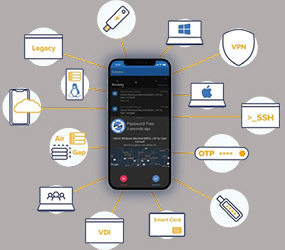
PasswordFree© is designed to integrate into existing enterprise ecosystems without requiring full infrastructure replacement. It supports integration with major identity providers such as Azure AD, Okta, Ping Identity, and Keycloak through SSO, RADIUS, and API-based connections.
This flexibility allows organizations to adopt passwordless authentication without disrupting existing workflows or security policies. It also enables gradual migration strategies, where passwordless systems coexist with legacy authentication during transition phases.
The platform is designed to scale across industries, including financial services, healthcare, government, and retail.
Security Beyond Authentication
One of the key differentiators in PasswordFree's© approach is its emphasis on extending security beyond authentication into authorization. Traditional systems often treat login as the primary security checkpoint. Once access is granted, internal systems frequently rely on trust assumptions that can be exploited.
Authentication answers one question: who is attempting to enter? Authorization answers another: what should that person be permitted to do? Treating the first answer as permanent proof for the second creates unnecessary risk.
By supporting continued identity assurance through trusted device, biometric, and contextual signals, PasswordFree© is designed to reduce the risk of unauthorized actions after the initial authentication event.
This becomes particularly important in environments where compromised accounts or insider threats can lead to significant data exposure.
Business Impact and User Adoption
Beyond security improvements, PasswordFree© is positioned as a driver of measurable business outcomes. In digital commerce environments, reducing login friction can directly influence conversion rates, registration completion, and cart abandonment.
Simplified authentication can improve onboarding and engagement by removing one of the most persistent sources of friction in the digital experience. By removing passwords, organizations also reduce dependency on recovery systems, helpdesk interventions, and password reset cycles.
The broader impact is both operational and financial, with the potential for reduced support overhead and improved user satisfaction.
A Shift Toward Passwordless Identity Ecosystems
The broader industry trend is moving toward identity-centric security models, where authentication is continuous, adaptive, and context-aware. PasswordFree© aligns with this shift by eliminating static credentials and replacing them with dynamic trust validation.
 This represents not just a technological change, but a philosophical one. Identity is no longer something that is checked once at login. Digital trust must be established with confidence and maintained throughout the interaction.
PasswordFree's© approach reflects a broader transformation in cybersecurity thinking. Instead of reinforcing outdated systems, it proposes removing their foundational weakness entirely.
As Coterillo states:
“We are eliminating passwords entirely and creating a more secure foundation for digital trust. Because if we cannot establish with confidence who is participating in a digital interaction, everything we build on top of that identity rests on uncertain ground.”
By combining Full Duplex Authentication®, device-based identity, and biometric verification, Identit©® is challenging one of cybersecurity's oldest assumptions: that only the user should have to prove who they are. Its approach moves authentication beyond passwords and one-way verification toward Mutual Trust, where both sides of a digital interaction can establish confidence in the other. As AI makes impersonation easier and digital interactions harder to judge by appearance alone, trust can no longer be assumed. It must be mutual. It must be verifiable. And it must work both ways.
What Modern Multi-Factor Authentication Must Prove
Cybersecurity leaders no longer evaluate multi-factor authentication as a narrow login control. It now sits at the center of trust because the network perimeter has been replaced by cloud applications, remote access, mobile users and third-party services. Attackers have adapted. Rather than defeating infrastructure directly, they target the human identity layer through phishing, fake websites, credential reuse, session interception and social engineering. AI has sharpened deception, weakening legacy assumptions about passwords, one-time codes and user vigilance.
Traditional MFA can reduce some exposure, but it often preserves the weakness it is meant to protect. A password remains in the path, a user still has to recognize a fraudulent prompt, a code may still be entered into a hostile session and the burden of correctness often sits with the individual. For executives, this is not just a security design problem. It becomes a cost, productivity and confidence problem. Help desks carry reset volume, employees navigate repeated prompts, customers abandon frustrating processes and fraud teams absorb losses when authentication stops at login but fails to control sensitive actions after access is granted.
The stronger path removes static credentials from daily use rather than hiding them behind more steps. It should make trust mutual, so the service proves itself to the user before the user approves the session. It should also extend beyond login, because access to payroll, funds transfer, privileged systems or sensitive records requires authorization tied to the verified person, not just an earlier sign-in. Biometric confirmation, device trust, cryptographic validation and context-aware checks matter most when they reduce the chance that a stolen credential, copied website or compromised session can become real damage.
Adoption depends just as much on usability. Security teams have spent years asking users to remember, rotate, reset and protect secrets while interpreting security cues under pressure. That model does not scale across banking customers, public-sector users, field employees, shared workstations, legacy applications and VPN access. The right approach should simplify the act of proving identity, accommodate users with different levels of digital confidence and integrate across environments that cannot all be rebuilt. Simplicity is not softness. It is the discipline of reducing unnecessary steps while preserving proof, control and auditability.
Executives should also look for coverage that matches enterprise reality. A solution that works only for new cloud applications can leave exposed systems behind. One that requires broad redesign can slow adoption. One that replaces a single password burden with multiple disconnected authentication paths can dilute governance. The benchmark is a consistent identity experience across cloud, desktop, VPN, legacy, shared and constrained environments, backed by implementation support that lets security leaders test, train and expand without disrupting users.
Password Free emerges as the premier choice for organizations that want MFA to move from layered passwords toward true password elimination. Its differentiator is full duplex authentication, in which the service validates itself to the user before the user confirms identity through a matched image, short code and biometric approval. That design addresses phishing, imposter websites and one-way code entry. Its website scope reinforces the fit through passwordless authentication, Windows Hello extension and coverage across cloud, desktop, VPN, legacy, shared and air-gapped systems. For buyers prioritizing trust, broad reach and user simplicity, Password Free offers the clearest path forward.
...Read more

Company
Password Free
Management
Eusebio Coterillo, Co-Founder
Description
Password Free, developed by Identité, is redefining digital authentication by eliminating passwords entirely. Built on patented Full Duplex Authentication, it enables mutual verification between user and service, reducing phishing risk while delivering a frictionless, device-based, biometric-secured login experience for modern enterprises and digital platforms.
-1.jpg)
