THANK YOU FOR SUBSCRIBING
× 
Enterprise Security Mag Weekly Brief
Be first to read the latest tech news, Industry Leader's Insights, and CIO interviews of medium and large enterprises exclusively from Enterprise Security Mag
Enterprise Security Magazine

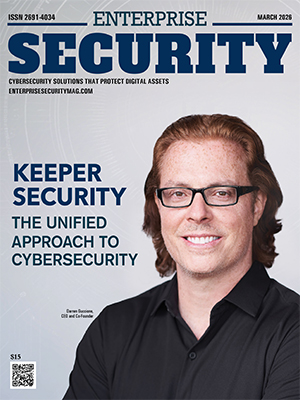
Keeper Security
The Unified Approach to Cybersecurity
 Darren Guccione, CEO and Co-Founder
This reality is driving a fundamental shift in how security leaders think about privileged access management (PAM). Historically, PAM was built for protecting IT administrators from becoming insider threats. It was siloed, departmental, and reactive. Today, that no longer reflects reality. Privileged access exists far beyond IT, extending into finance, customer support, engineering, contractors, and automated systems. Every user, device and machine identity is a potential entry point for attackers – both internal and external.
Keeper Security’s bet is that PAM must evolve from a narrow control into a unified, enterprise-wide platform that governs identity everywhere. Over the past several years, the company quietly rebuilt its architecture around that premise, unifying password management, secrets management, zero trust network access, remote browser isolation and endpoint privilege management into a single system.
“The goal was not incremental improvement but structural change: eliminating the seams between tools that attackers routinely exploit. It’s a model designed for how modern environments actually operate, not how security tools have historically been packaged,” says Darren Guccione, CEO and Co-founder of Keeper Security.
From Siloed Controls to Unified Identity
At the foundation of this approach are two principles that have become widely discussed in modern security but are rarely implemented comprehensively. Zero knowledge ensures that customers, not vendors, retain exclusive control over encryption keys and sensitive data. Zero trust eliminates standing privileges, replacing them with just-in-time access that is continuously verified and monitored. Together, they create an environment where access is never assumed and data is never exposed – by design.
What differentiates this model is its scope. Rather than confining privileged access to IT administrators, Keeper extends the same controls across the entire organization. Passwords and credentials protect human users. Secrets management secures machine identities. Vaults reside on every authorized device, enabling consistent enforcement regardless of location or network. Access to infrastructure occurs within the platform itself, removing the need for separate third-party tools that fragment visibility, policy enforcement, and reporting. Integrated capabilities like dark web monitoring and real-time alerts further extend visibility beyond the perimeter, helping organizations detect risk before it escalates into compromise.
This matters because the modern attack surface is not defined by servers or networks, but by people. Cybercriminals increasingly target non-technical employees precisely because traditional security tools overlook them. A single compromised finance user can become the starting point for a horizontal attack that moves laterally through an organization, escalating privileges until critical systems are exposed. Preventing that scenario requires visibility that spans all departments, devices, and workflows in real time.
Visibility, in fact, has become the defining concern for security leaders. Ask any CISO what keeps them awake at night, and the answer is rarely a lack of tools. It is the fear that something is happening inside their environment that they cannot see: who has access, from which device, under what conditions, and whether that behavior deviates from normal patterns in ways that signal risk.

The goal was not incremental improvement but structural change: eliminating the seams between tools that attackers routinely exploit. It’s a model designed for how modern environments actually operate, not how security tools have historically been packaged.

Visibility, in fact, has become the defining concern for security leaders. Ask any CISO what keeps them awake at night, and the answer is rarely a lack of tools. It is the fear that something is happening inside their environment that they cannot see: who has access, from which device, under what conditions, and whether that behavior deviates from normal patterns in ways that signal risk.
When AI Becomes Enforcement, Not Insight
Keeper’s approach to artificial intelligence predates the current wave of generative tools. In 2011, long before AI became a cybersecurity buzzword, the company introduced an autofill capability that used heuristics and behavioral modeling to interpret login forms and securely inject credentials directly from the vault. By eliminating manual entry, particularly on mobile devices, this early use of machine intelligence reduced exposure to phishing, keylogging, and human error.
That foundation continues to inform how AI is applied across the platform today. Privileged users are continuously parameterized based on historical behavior and organizational controls. When actions fall outside expected bounds, sessions can be terminated instantly, recorded down to the keystroke, and escalated to administrators without human intervention. Waiting weeks to analyze logs after a breach is no longer acceptable when AI can intervene in real time.
The same philosophy extends to the emerging intersection of security and large language models. As organizations integrate AI into workflows, they face a new category of risk: uncontrolled access between LLMs and sensitive infrastructure. Keeper positions its secrets management system as a broker between AI tools and enterprise environments, ensuring that queries, rotations, and discoveries occur within established zero trust and zero knowledge boundaries, preserving governance even as automation accelerates.
Proving the Model at Scale
The impact of this approach becomes clearer when viewed through a real-world lens. A large European bank with hundreds of thousands of users operating across geographies and regulatory regimes had invested heavily in security tools but lacked a unified view of access across its workforce. Administrators could not easily determine whether users were under active attack on the dark web or engaging in behavior that increased organizational risk. Compliance reporting was slow, manual, and often incomplete.
By consolidating identity and access controls into a single platform with the help of Keeper, the bank gained immediate visibility into user activity across devices and locations. Privileged access became temporary, contextual, and auditable. Compliance reports that once took weeks could be generated in minutes and they shifted from reacting to incidents after damage occurred to preventing them in real time.
That distinction is critical. No security vendor can credibly claim to be a silver bullet, and Keeper does not attempt to do so. Instead, the company argues that identity-centric security delivers the highest return on investment because it addresses the most common root cause of breaches. For small and mid-sized businesses, which represent roughly 90 percent of global GDP and are disproportionately targeted by attackers, this materially reduces breach risk with a single, cost-effective deployment. For larger enterprises, the same approach simplifies complex environments while strengthening control and compliance.
Today, Keeper supports more than 80,000 organizations and over 4.2 million users worldwide. Its platform is authorized at the FedRAMP High level, certified under GovRAMP (formerly StateRAMP), and is in the process of achieving IL5 authorization for the U.S. Department of Defense. That combination of scale and regulatory rigor underscores the platform’s ability to deliver consistent visibility and control across diverse environments.
As attackers continue to automate and scale their efforts, defenders must do the same. The next era of cybersecurity is defined by identity as the perimeter and intelligence-driven enforcement at every layer. Keeper leads this evolution, delivering trusted protection for organizations of all sizes in an increasingly complex threat landscape.
Closing the Gaps in Modern Privileged Access
Modern identity and access management necessitates a shift away from fragmented point solutions that have historically prioritized the technical isolation of IT departments over the broader security needs of the business. Traditional privileged access management (PAM) models often fail because they create visibility gaps where human and machine interactions intersect with legacy infrastructure. Current industry challenges stem from a reliance on layered, non-communicative tools that generate significant reporting friction, leaving organizations vulnerable to horizontal attacks. Decision-makers must prioritize platforms that consolidate password management, secrets management, zero-trust network access, and endpoint privilege management into a single administrative console to eliminate these operational vulnerabilities.
An effective evaluation of any next-generation platform should focus on the depth of its zero-knowledge and zero-trust architecture. Security leaders require a framework where the client maintains exclusive control over encryption keys and master passwords, ensuring the vendor remains incapable of viewing or decrypting sensitive data. Beyond encryption, the criteria for a robust solution include the ability to monitor and record privileged sessions down to the keystroke while maintaining an agentic AI layer for real-time threat detection. This automation is essential for modern enterprises because it allows for the immediate termination of suspicious sessions without waiting for manual intervention or retrospective data analysis.
Scalability remains a critical pain point as cyber threats increasingly target non-technical departments like finance and customer service. A gold-standard solution must extend its protective vault to every employee and device across the organization rather than being relegated to a small subset of privileged users. Integration with large language models through secure protocols like the Model Context Protocol is also becoming a non-negotiable requirement for organizations looking to leverage AI without exposing internal infrastructure or secrets. Comprehensive reporting that satisfies complex regulatory audits such as Sarbanes-Oxley within minutes rather than days is the final hallmark of a mature identity platform.
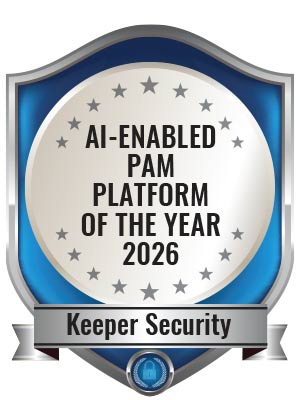
Keeper Security establishes itself as the definitive leader in this space by being the first to unify the four critical components of the identity and access management framework into a single privileged access management solution. It offers an agentic AI layer that automates session monitoring and response and utilizes a zero-knowledge architecture to ensure absolute data privacy. The platform effectively bridges the gap between human password management and machine secrets management, providing the pervasive visibility and control required to mitigate up to 80 percent of data breach risks. For executives prioritizing a consolidated, AI-enabled PAM platform, Keeper represents the most secure and cost-effective path toward enterprise-wide zero trust.
...Read more
Company
Keeper Security
Management
Darren Guccione, CEO and Co-Founder
Description
Keeper Security is a leading cybersecurity company offering an advanced Privileged Access Management (PAM) platform with integrated AI tools. It provides scalable, cost-effective protection for organizations of all sizes, securing both human and machine assets across all users, devices, and locations to mitigate cyber risks.