
THANK YOU FOR SUBSCRIBING
× 
Enterprise Security Mag Weekly Brief
Be first to read the latest tech news, Industry Leader's Insights, and CIO interviews of medium and large enterprises exclusively from Enterprise Security Mag
Enterprise Security Magazine

HandyTrac Key Control
Bringing Accountability to Key Management

 Ryan Keim, CEO
That’s where HandyTrac Key Control comes into play. Its HandyTrac electronic key control system is designed to create accountability for key access, helping property-management teams address premises liability and poor record-keeping. For Ryan Keim, CEO of HandyTrac Key Control, those needs directly translate into the system’s value.
“Our system provides an audit trail of who took the key, when they took the key and if they’ve returned the key,” says Keim. “We’re helping them with their record keeping. We’re reducing their liability for the community, while also providing security for the residents as well.”
Knowing Who Has the Key
Users enter the system through biometrics, a badge or a PIN and select a reason for requesting a key. A leasing agent showing a vacant unit, for example, can record that purpose before the system directs the user to the appropriate key.
That creates a record of the transaction from the moment an authorized employee requests the key. Keys are attached to anonymous barcoded tags, and the system assigns a different hook when they are returned. Someone who gains access to the cabinet cannot easily identify a key by its label, while an employee attempting to bypass the process cannot rely on a memorized location.
The transactions are backed up online, allowing authorized managers and administrators to review activity by unit or employee and see which keys are out. For property managers, this provides a current view of key activity rather than requiring them to rely only on end-of-business checks or older printed reports.
The system’s online connection is also closed, with the system connecting directly to HandyTrac’s website rather than allowing access to other websites.
The company is also focused on giving property managers control over who can access specific units. Administrators can restrict certain units to specific personnel or prevent particular employees from requesting keys to certain units. This adds another layer of control for organizations managing access across their properties.
Extending Key Control beyond the Cabinet
The HandyTrac systems also offer app access, giving users another way to interact with the key-control system beyond the cabinet. HandyTrac Key Control is currently developing an in-field transfer feature that would allow users to identify keys in the field and hand them to another authorized user while maintaining continuity of the audit trail. The feature is still in development and is not currently live.

Our system provides an audit trail of who took the key, when they took the key and if they’ve returned the key.

The company is also focused on giving property managers control over who can access specific units. Administrators can restrict certain units to specific personnel or prevent particular employees from requesting keys to certain units. This adds another layer of control for organizations managing access across their properties.
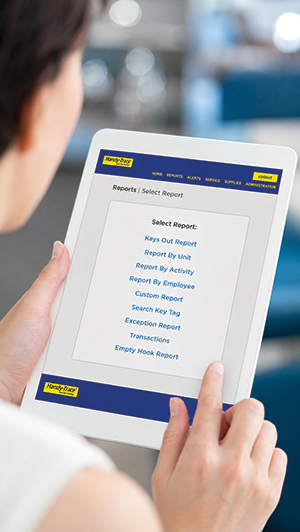 The evolution reflects another requirement: the system has to work for the people using it. Maintenance personnel, leasing staff and managers may have different levels of comfort with technology. Ease of use, therefore, remains an important consideration in the system’s development. Live technical assistance is also available when customers need help.
Built for Scale and Value
After 25 years of selling HandyTrac systems, HandyTrac Key Control has about 22,000 customers and protects more than 6 million units. Its client base is growing by about 1,000 subscribers a year, including one year when it added roughly 2,500. The subscription also includes a comprehensive warranty covering the cabinet, lock and computerized components, including the touchscreen.
Value is another part of the company's offering. HandyTrac is positioned as one of the industry's lower-priced key-control systems while maintaining a focus on customer service.
As key control evolves, HandyTrac gives organizations a record of who accessed a key, when it was taken, why it was requested and whether it was returned. App access is available across the company's systems, while the planned in-field transfer capability is being developed to eventually extend that accountability beyond the cabinet.
That continuing focus on accountability, supported by decades of use, scale, reliability and customer service, is what makes HandyTrac Key Control the Electronic Key Control System of the Year 2026.
Tighter Key Custody without Added Staff Friction
A missing master key rarely stays an inventory problem. Once a property cannot establish who removed it or when custody changed, the incident becomes a liability question tied to resident access and internal accountability. Paper logs and shared sign-out sheets often fail at the point investigators need them most. Entries can be skipped or rewritten, while the record may still be detached from the person who actually handled the key. The purchasing question is not simply how securely keys are stored. It is whether custody can be reconstructed without relying on memory.
Evidence quality separates a controlled key room from a cabinet that merely locks. Each checkout should be tied to an authorized user and a stated purpose, with both removal and return times preserved automatically. Managers also need a current view of keys still outside the cabinet rather than a report generated only after a shift ends. That matters when an unresolved key can trigger a search or delay closeout. It can also complicate a later claim when the record cannot show who held custody.
"HandyTrac Key Control’s HandyTrac Platinum Touch system places keys in a locked cabinet on anonymous barcoded tags and returns them to randomized hook positions, limiting the value of memorized locations."
Physical security requires more than a strong door. A compromised cabinet becomes far more consequential when tags reveal exactly which door each key opens. Buyers should examine whether the storage method exposes unit identity and whether returned keys settle into predictable locations. Credential design deserves the same scrutiny. Shared codes weaken accountability, while unrestricted permissions give legitimate users more access than their jobs require. A sound system should let administrators narrow access without making every routine request dependent on a manager.
Daily use is the pressure test. Key control sits directly in the path of leasing visits and maintenance work. If checkout takes too long or return steps are awkward, staff will look for shortcuts. The interface should make authorized requests quick while still recording the reason for access. Mobile visibility matters when a key remains in the field beyond the original task. A key may also pass between authorized employees before it returns. The audit record should follow that movement rather than break at the cabinet door.
Service design belongs in the same purchase decision because these systems become part of routine access control. Buyers should ask how warranty coverage works and whether support reaches a live technician when a cabinet or interface issue interrupts key release. The strongest fit is not necessarily the system with the longest feature list. It is the one that can keep accurate custody records while remaining simple enough for varied staff to use consistently.
Against those requirements, HandyTrac Key Control is a premier choice for buyers needing disciplined custody without turning key access into an administrative burden. Its HandyTrac Platinum Touch system places keys in a locked cabinet on anonymous barcoded tags and returns them to randomized hook positions, limiting the value of memorized locations. Authorized users can enter through biometric verification or badge credentials, while activity codes and live reports preserve the custody record. The app extends that record by tracking keys outside the cabinet and supporting user-to-user handoffs. Unit restrictions give managers tighter permission control. A subscription-backed warranty and live phone support also reduce service uncertainty. For properties prioritizing traceable access and practical staff use, HandyTrac Key Control merits close consideration.
...Read more
Electronic Key Control Systems Info
Q1
What Are Electronic Key Control Systems?
Keeping track of physical keys can be difficult when several employees need access to the same property. Electronic Key Control Systems make this easier by securely storing keys and recording who takes them, when they are removed and whether they have been returned. Instead of relying on handwritten registers, employees use a PIN, badge or biometric identification to retrieve keys. These systems are especially useful in property management, where leasing and maintenance teams regularly need access to apartments and restricted areas. Digital records give managers a clearer picture of key activity and help them identify missing keys.
Q2
How Does Biometric Key Control Improve Accountability for Property Managers?
Biometric Key Control's HandyTrac platform records each key transaction, giving property managers a way to track access from the moment an employee requests a key. Employees identify themselves through biometrics, a badge or a PIN and provide a reason for retrieving it. The system uses anonymous barcoded tags, while keys are returned to different hooks, making them difficult to identify without authorization. Transaction records are backed up online, allowing managers to see which employee accessed a particular unit and whether any keys remain outstanding.
Q3
Why Is an Audit Trail Important in Electronic Key Management?
When a key goes missing, one of the first questions is who had it last. Electronic Key Control Systems help answer that question by automatically recording every withdrawal and return. Managers no longer have to rely entirely on handwritten entries or employees remembering when they last used a key. These records can also help when questions arise about access to restricted areas. By reviewing transaction histories, property managers can investigate incidents, identify where procedures may have broken down and take steps to prevent similar problems.
Q4
What Should Property Managers Look for in a Key Control System?
A key control system should make everyday access straightforward for employees without compromising security. Property managers comparing Electronic Key Control Systems should look at how employees are authenticated, whether access can be restricted to specific units and how easily managers can review key activity. Online reporting is particularly useful for identifying outstanding keys without checking cabinets manually. Equipment reliability and technical support also deserve attention, especially when leasing and maintenance teams depend on frequent access. The right system should give managers greater control without making routine work unnecessarily complicated.
Q5
How Does Biometric Key Control Support Large Property Portfolios?
Biometric Key Control has spent approximately 25 years helping property managers keep track of physical keys through its HandyTrac platform. The company serves around 22,000 customers, with its technology protecting more than six million units. Administrators can restrict access to particular units or employees and use the app to review key activity. Live technical assistance and a subscription warranty covering cabinet and computerized components provide additional support. The company is also developing an in-field key transfer feature designed to preserve transaction records when authorized employees exchange keys away from the cabinet.
Q6
How Can Electronic Key Control Reduce Security and Liability Risks?
A physical key may provide access to someone's home, making it important to know who can retrieve it and where it goes. Electronic Key Control Systems help property managers maintain that control through employee authentication, access restrictions and automatic transaction records. Managers can limit which units employees can access and review key histories when something goes missing or an access concern arises. For multifamily properties, these measures can help reduce uncertainty, strengthen accountability and support efforts to protect residents and their homes.
Company
HandyTrac Key Control
Management
Ryan Keim, CEO
Description
HandyTrac Key Control delivers secure electronic key management solutions through its HandyTrac system, helping organizations strengthen accountability, reduce premises liability and maintain accurate key activity records with biometric access, anonymous key identification and online reporting. The company is also developing additional mobile capabilities to extend key control beyond the cabinet.
