THANK YOU FOR SUBSCRIBING
× 
Enterprise Security Mag Weekly Brief
Be first to read the latest tech news, Industry Leader's Insights, and CIO interviews of medium and large enterprises exclusively from Enterprise Security Mag
Enterprise Security Magazine

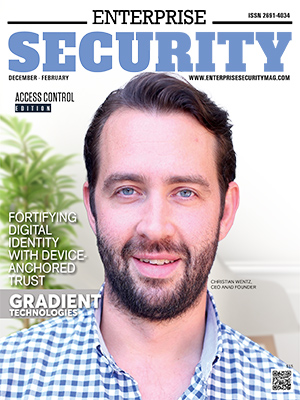
Gradient Technologies
Fortifying Digital Identity With Device-Anchored Trust

 Christian Wentz, CEO And Founder and Chris White, COO
It is clear that traditional identity management solutions are no longer sufficient. Organizations need to innovative secure authentication methods to protect their data and systems against modern threats.
While the industry recognizes the problem and has attempted to address it with hardened standards for multi-factor authentication (MFA), such as those from the FIDO alliance, improvements have been incremental at best. We have seen some of the largest and most sophisticated companies have credentials breached by adversaries with alarming ease. In 2023, technology giants such as Microsoft have suffered breaches stemming from token-stealing malware that evaded EDR detection and the protections of MFA. Okta saw direct theft of its customer critical session credentials as a result of a compromised employee account. According to Christian Wentz, founder and CEO of Gradient Technologies, MFA barely scratches the surface of this deep-seated challenge.
“Multi-factor authentication doesn't solve credential-compromised threats at the core. Authentication processes still result in tokens, which, if stolen, render security measures ineffective,” says Wentz.
Gradient Technologies has developed the Gradient Cybersecurity Mesh (GCM) platform, a solution that anchors credentials— such as SAML tokens, SSH keys, X.509 certificates, and API tokens—to the hardware of devices and orchestrates them across multiple platforms. It vastly simplifies the user experience, and executes a paradigm shift in how applications, data, and AI/ML systems are protected. This enables more security, with less friction for users and admins.
Hardware Anchoring for Enhanced Security
The world is witnessing a massive transformation, particularly in how we interact with a swath of devices. As conventional authentication measures—applied across cloud-based applications and on-premise devices—teeter on the brink due to intrinsic vulnerabilities, Gradient Technologies’ GCM emerges as a uniquely innovative solution.
Designed to address the foundational flaws in identity management and authentication, GCM leverages hardware-based trust roots, ephemeral credentials, and continual attestation to fortify credential issuance and validate user identities. Gradient functions as a lightweight SaaS overlay that supplements existing authentication infrastructures. Itrigorously evaluates the underlying security state of devices as a precondition to issuing credentials. It then continually validates that the user has not changed, nor has the security posture of the device. If any of these conditions fail, access is terminated for that user-device combination. Underpinned by a purpose-built Secure Enclave Processor, Gradient can stand resilient against nation-state-level threats, ensuring the integrity of credentials and access operations.
Over half of the sub-tactics listed in the MITRE ATT&CK Framework are mitigated, removing a substantial class of attack vectors. Gradient Technologies’ innovative approach embodies proactive defense that transcends the incremental improvements made under today’s detection and response paradigm.
“Gradient represents prevention built-in from the get-go. Our methodology defeats a massive percentage of attacks while fundamentally improving the user’s authentication experience. Users ‘just get in’ if they're authorized,” said Chris White, COO of Gradient Technologies.
GCM is not limited to end-user devices and authentication use cases. It functions similarly to Cloud infrastructure. Upon securing the underlying endpoint, the platform issues a credential, binding it cryptographically to said device. From there, a TLS tunnel can be created from it to any endpoint or application, creating a true zero-trust mesh architecture.
“Enhancing security with traditional multi-factor authentication is just kicking the can down the road. We completely eliminate the need for passwords and MFA interruptions to provide a truly frictionless user experience around authentication and access,” states Wentz.
The rapid rotation–fully configurable and customizable–guarantees the undisturbed functioning of any applications vested in the authentication device. Monitoring spans from hardware and firmware to the OS and app layers, ensuring their integrity. This allows Gradient to empower enterprises with ironclad access management, laying the groundwork for robust, zero-trust security.
Championing Deployment Simplicity and Compatibility
Businesses often hesitate to embark on massive architectural overhauls, like zero-trust, cloud, and micro-segmentation migrations. This stems from the valid concern of potential disruption in day-to-day operations. Along with the inevitable learning curve, architectural overhauls can lead to material dips in efficiency.
Gradient stands out in this context because it can enable migration to any of these architectures with a simple software deployment followed by simple configurations—which is done incrementally at a pace suitable for each enterprise.
Businesses can quickly deploy the platform without infrastructural forklifts. Modifications for identity systems, networks, and cloud infrastructures are not required. Gradient can be edge-or-core-deployed on physical and virtual platforms with simple configurations of existing identity frameworks.
Its back-end infrastructure is much different from its market alternatives. Gradient Technologies has developed its own public cloud-hosted secure enclave processors, purpose-built to execute stringent security policies. This approach will be critical as cyberattacks become more sophisticated and widespread. While maintaining its hardware anchoring capabilities, the company provides support to cloud-native environments and the ability to deploy on all major domestic cloud platforms. Gradient is compatible with various platforms and operating systems, including Windows, Linux, iOS, MacOS, Android, etc. Whether oil and gas, finance, manufacturing, education, or pharmaceutical, the platform is utilized across various industries, where it is easily tailored to each industry's threat profile.
This platform and industry agnosticism prove highly advantageous, especially in IoT and OT environments where the interface between the two ecosystems presents inherent vulnerabilities.
Gradient solves immediate challenges, streamlines user experience, and is built to steer ahead of evolving threats and regulatory policy. It is not only built for today; it's a solution for tomorrow

Gradient has been seamlessly embedded into IoT and OT systems for numerous industrial control and identity authentication systems. Its core strategy securely tethers identities to these entities, facilitating encrypted interactions and furnishing administrators with a comprehensive view of devices.
“Our cybersecurity mesh unifies processes across different silos, providing a unified identity framework for robust security and driving a true zero-trust vision across an enterprise,” says Wentz.
A case in point is Gradient's collaboration with a Fortune 50 oil and gas corporation to revamp their control systems digitally. The project intended to connect their IoT components with Azure Cloud, issue security certificates, and orchestrate them across their on-prem devices. Gradient Technologies used its lightweight deployment approach to build trust in extant hardware and unified identities between IoT assets and cloud infrastructure.
Safeguarding Digital Trust in Evolving Regulatory Landscapes
There have been major regulatory changes in recent times, and one aspect that stands out is device trust.
Device authenticity must be established to ensure they remain in a state of trust, free from any compromise. Gradient proves to be of immense value here as it allows administrators to demonstrate their device security, simplify cybersecurity programs, and remain compliant with prominent regulations, including the NIST Cybersecurity Framework and European Cybersecurity Act.
“Gradient ensures that the device and software continually operate in trusted state and anchors credentials - including the easily stolen session credentials - in the root of trust, explicitly addressing various regulations. Since we strongly authenticate the device, user and software, our platform solves essentially all identity-compromise attacks.” Says Wentz.
Due to its platform capabilities and deployment approach, Gradient Technologies is hailed as the next-generation authentication single sign-on platform. It is often the go-to solution for enterprises attempting to mitigate the risks of identity-based attacks. This recognition is underpinned by the firm’s dedication to addressing the overwhelming influx of regulations, encouraging businesses to embrace these innovations without delay.
“Gradient solves immediate challenges, streamlines user experience, and is built to steer ahead of evolving threats and regulatory policy. It is not only built for today; it's a solution for years to come,” says White.
An evocative example is Gradient Technologies’ implementation of post-quantum upgradeable cryptography—a multi-year, multi-million-dollar project with the U.S. Defense Department, where the firm developed encryption schemes for deployed devices that can be upgraded on the fly. The primary objective was to enable remote encryption scheme upgrades, eliminating the need for field-deployed devices to be physically retrieved and modified.
Additionally Gradient Technologies helped a large educational institution streamline the authentication issuance of its certificate-based infrastructure. Using Okta as their primary identity management system, the client had thousands of users, BYODs, workflows, managed machines, data, and other critical resources. Substantial time was spent troubleshooting when users were required to install a new certificate. This involved visiting the official website, entering their credentials, followed by downloading and installing the certificate in the browser, draining helpdesk resources, and consuming weeks of their valuable time. The institution received millions of dollars for research as part of a federal defense contract and was regularly subjected to nation-state security threats. At this stage, transitioning from manually renewed to automated rotation of credentials was a sufficient value proposition for the client to adopt Gradient. However, the platform delivered more.
“We completely eliminate the need for passwords to provide a truly frictionless user experience around authentication and access”
Gradient streamlined access control, as well as enhanced user experience and operational efficiency. Credential lifetimes were reduced from a year to hours, which assisted in compliance with the Cybersecurity Maturity Model Certification. No MFA or certificate renewal was required, allowing users to access the resources to which they were authorized.
In all its client engagements, the aspect of user experience stands out as exceptional. Customers constantly express their satisfaction with Gradient Technologies, often stating that Gradient is one of the few tools that end-users genuinely enjoy. Similar feedback is received from security admins as it eliminates unnecessary complexity. With this feedback, the team remains vigilant about customers’ evolving needs.
Gradient practices monthly sprints where they gather feature requests to enhance the product experience, such as integration with security orchestration and automated response (SOAR), security incident, and event management (SIEM). Gradient incorporates these suggestions every month to ensure customers benefit from ongoing improvements and integrations with other technology ecosystems.
As an engineering company, Gradient Technologies is home to experts in full-stack software development, security architectures, hardware security primitives, asymmetric and symmetric encryption, post-quantum cryptography, and more. Though it delivers SaaS, its team’s extensive understanding of the nuances of hardware allows it to pioneer (and patent) hardware anchoring techniques.
In the near future, Gradient plans to offer its products to smaller entities that struggle to access adequate cybersecurity solutions and services. Since conventional, low-cost antivirus alternatives are no longer sufficient or relevant in the increasingly cloud-centric small business, Gradient Technologies looks forward to addressing this gap by making its core solutions affordable and easily accessible for these organizations.
With C-suite heavily investing in cybersecurity frontiers today, the world is marching toward a better-protected future. While the omnipresent digital danger of data breaches plagues the cyber world, Gradient Technologies’ presence in the industry hints at a promising glimpse of what lies ahead.

Company
Gradient Technologies
Management
Christian Wentz, CEO And Founder and Chris White, COO and Christian Wentz, CEO And Founder and Chris White, COO
Description
Gradient Technologies offers its Gradient Cybersecurity Mesh (GCM) Platform, a solution that eliminates the fundamentally insecure ways of identity management and authentication. It anchors credentials to the hardware of devices down to silicon levels and orchestrates them across multiple platforms and silos. Gradient puts users at the center of identity-based authentication, simplifies their experience, and executes a paradigm shift in how data, applications, and devices are accessed.