
THANK YOU FOR SUBSCRIBING
× 
Enterprise Security Mag Weekly Brief
Be first to read the latest tech news, Industry Leader's Insights, and CIO interviews of medium and large enterprises exclusively from Enterprise Security Mag
Enterprise Security Magazine: Specials Magazine
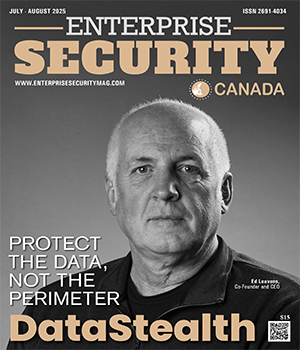
or years, data security focused on building defenses around the data—fortifying applications, networks and storage systems with firewalls, access controls and perimeter protections. But this approach left a critical gap—the data itself remained vulnerable, especially when in motion between systems. DataStealth flips that model. Instead of merely securing the environments that store data, it secures the data itself—no matter where it lives or how it moves. Through its Data Security Platform (DSP), DataStealth embeds protection directly into the data flow, dynamically applying tokenization, encryption and masking without altering application code or underlying systems. Whether data is at rest or in transit, it remains protected at the source. Deployment is equally innovative. With a simple Domain Name System (DNS) change, traffic is seamlessly rerouted through DataStealth’s intelligent security layer—no software installations, integrations or development projects required. What typically takes months can now be accomplished in just a few hours. Unlike most tools that struggle with legacy systems, DataStealth uses the same deployment model to secure everything from Salesforce and Okta to on-prem mainframes— bridging the gap between old and new IT environments with ease. “Think of DataStealth like a box of Lego blocks,” says Ed Leavens, co-founder and CEO. Depending on what a business needs to solve, whether regulatory compliance, cloud security or safer DevOps environments, they can pull the right pieces and assemble the protection that fits. They don’t have to rebuild everything; they simply adapt the platform to their needs. That’s the power of our platform, one that’s modular, flexible and outcome-driven.” For governance, risk and compliance use cases, the journey begins with robust discovery and classification. DataStealth gives organizations visibility into their data landscape, including previously unknown sources—often referred to as Shadow IT. This visibility is critical for companies in regulated industries, where strict rules govern where data can reside and how it must be protected. Once organizations understand what data they have and where it lives, they can apply precise controls such as tokenization, dynamic data masking and encryption. These safeguards are tailored to user roles, access levels and compliance frameworks, ensuring protection is effective without being restrictive.
Digital Magazine
Enterprise Security
Cybersecurity has emerged as a significant challenge for businesses of all shapes, sizes and industries across the public and private sectors. In 2023, the Securities and Exchange Commission (SEC) released its 'Rules on Cybersecurity Risk Management, Strategy, Governance and Incident Disclosure' for publicly traded companies. With federal, state, and provincial regulations now in place and enforced, cybersecurity is increasingly prioritized as a strategic imperative by nearly every board and senior leadership team. Significant investments in people, processes, and technology are becoming commonplace, often focusing on implementing defensive and reactive measures. However, to effectively address the cybersecurity challenge, organizations must adopt a proactive approach. Proactivity enables organizations to stay ahead of evolving threats and safeguard digital assets and sensitive data. Canary Trap is a laser-focused, boutique offensive security services and advisory firm that specializes in delivering true adversarial offensive security (penetration) testing. "Our elite team of security experts can be contracted to test the security resiliency of your most critical digital assets and networks. We will identify, enumerate, and report on security gaps and vulnerabilities prone to exploitation by sophisticated cybercriminals," says Daniel Pizon, president and CEO of Canary Trap. "Undertaking regular penetration testing and related security assessments has long been established as a best practice." Employing more than thirty (30) highly skilled, credentialed, and certified security experts, Canary Trap specializes in conducting penetration testing against external and internal networks, web and mobile applications, APIs, and wireless security assessments. Additionally, Canary Trap offers assessment and advisory services, including Microsoft 365 security controls reviews, cloud configuration reviews, physical security assessments, and cybersecurity incident management planning. These services uncover unknown vulnerabilities, gaps, and weaknesses that could be exploited. Canary Trap continuously refines and enhances its processes and methodologies that underpin service delivery. This is achieved through strategic investments in new technologies, capabilities, and, most importantly, its employees. All Canary Trap employees are allocated a significant annual training budget to upskill and keep pace with the ever-changing threat landscape. At the conclusion of each engagement, Canary Trap delivers a Report of Findings that showcases the results of testing, along with any identified security gaps prioritized by risk and impact. The company conducts a robust Quality Assurance (QA) process to ensure accuracy.

Security AI

alo Alto Networks has long been recognized as a frontrunner in the global cybersecurity space. Its next-generation firewalls and comprehensive cloud security solutions have created a legacy of products that help clients stay one step ahead of evolving threats. As the global landscape shifted and enterprise needs became more dynamic, the company continued to evolve—particularly as artificial intelligence (AI) gained prominence in recent years. Palo Alto Networks integrated AI capabilities into its latest suite and launched its ‘Secure AI by Design’ portfolio powered by its proprietary system, Precision AI. The objective? To empower enterprises to reimagine their cybersecurity strategies by deploying AIpowered cybersecurity to counter AI-driven cyber-attacks. Precision AI automates the detection, prevention and remediation of AI-associated threats with high accuracy. It leverages machine learning (ML) and real-time threat detection to safeguard networks, cloud environments and AI-powered applications. Using Precision AI as its core, Palo Alto Networks aims to provide intelligent cybersecurity solutions that ensure enterprise security remains proactive and continuously evolves with emerging vulnerabilities. “Precision AI by Palo Alto Networks is the game changer that will create a new paradigm in security, perhaps for the first time where the defender is ahead of the adversary,” says Nikesh Arora, chairman and CEO. Securing The Genai Frontier Among the various types of AI, Generative AI has influenced the cybersecurity landscape the most. Its ability to rapidly generate convincing, context-rich content has become a powerful tool in the hands of malicious actors. By crafting highly targeted phishing campaigns with unprecedented speed and accuracy, GenAI has fueled an alarming uptick in credential theft and other cyberattacks. This scenario has raised a pressing question–How can organizations counter the stealth and sophistication of threats originating from the very platforms they use regularly? In such a high-stakes environment, Palo Alto Networks’ GenAI-focused solutions emerge as an indispensable ally. Each product secures a key enterprise AI security use case and utilizes ML models and behavioral analytics for real-time threat detection and prevention.
Access Control

How to Integrate Cyber Insurance into Your Company's Incident Response Plan
David Finz, Senior Vice President, Alliant Insurance Services
Data Security

Ogre's and Data Security
Cameron Yardy, Director of Cyber Security, First West Credit Union
Physical Security

Making Your Mark in the Security Space
Dennis Cheung, Director, Data Engineering and Governance, OSL Retail Services
Data Security

The Value of Corporate Intelligence
John Robert, Director, Global Intelligence & Protection Center, Dow
Physical Security

Is your privacy worth protection?
Tamer Nagy, Global Director of GRC, Colliers
Physical Security

Designing a Comprehensive Fraud Task Force in the Era of Real-Time Payments
Ron Kaine, AVP Fraud and Compliance Products and Services, Central 1
Access Control
Unlocking Value: Effective Security and Privacy Programs
Marian Serna, VP, Privacy & Cybersecurity, Skyline

IN MY OPINION
Data Security
Over Stimulating SIEM
Craig Newell, CISSP, CISA, CISM, CRISC, CDPSE, Vice President, Enterprise Information Security, GDI

LAST WORD
Data Security
Digital Crown Jewels - It's a High Stakes Game
Michael Laing, CISO & Senior Director of Cyber Security, Rogers Communications
IN FOCUS

Defensive Strategies for Canadian Enterprises: Improving Security in a Digital Age
In an increasingly digital era, enterprise security has become a critical concern for organizations of varying sizes. As businesses become more dependent on technology, the landscape of possible threats continues to evolve. Effectively navigating the complexities of enterprise security necessitates a strategic approach that integrates technological solutions, comprehensive employee training, and robust risk management practices
Canada's Digital Shield: Evolving Data Security Solutions
Data has emerged as a fundamental component of modern existence in the contemporary digital landscape, characterized by its vastness and inherent vulnerabilities. Every online activity, ranging from the management of financial records to personal communications, generates a digital trace. These traces, frequently imperceptible to the user, are persistently collected, stored, and sometimes targeted.
EDITORIAL
A Shift Toward AI-Driven, Compliance-Ready Cyber Defenses
Canada’s data security sector is shifting under pressure from regulatory reform, AI innovation and rising risk, which have forced a reset in how protection is designed and delivered. Bill C-26 and tighter PIPEDA standards push organisations to move beyond fragmented systems and toward defensible, transparent frameworks. Zero-trust architectures, identity-based access and hardened multi-cloud setups are quickly becoming standard for banking, healthcare and infrastructure. Compliance, resilience and trust now work in tandem.
In this climate, vendors must offer more than tools. They need fluency in Canada’s regulatory environment and the ability to support enterprise-level performance. Preference leans toward those who can deliver both.
AI has taken a central role. CrowdStrike, SentinelOne and Palo Alto Networks are embedding machine learning into core platforms—spotting anomalies, triggering automated responses and enabling predictive analysis. With cybersecurity talent stretched thin, organisations increasingly rely on technology to extend team capacity rather than just supplement it.
The lines between digital and physical security are also blurring. Biometric access, AI-powered surveillance and unified monitoring point to a broader shift: risk is no longer confined to network perimeters. It’s being viewed holistically.
For cloud-reliant businesses, especially mid-sized ones, managed detection and response (MDR) has become a strategic necessity. Few have the internal capacity to monitor threats around the clock, making outsourced support cost-effective and operationally sound.
With the Canadian cybersecurity market expected to grow at an 11.3 percent CAGR through 2030, momentum is with modular, cloud-native platforms that combine encryption, compliance automation and third-party risk management, without overcomplicating the stack.
Cybersecurity is no longer just an IT function. It’s a business imperative. In today’s environment, resilience belongs to the prepared.
The magazine features a thought leadership piece by Craig Newell, Vice President of Enterprise Information Security at GDI Integrated Facility Services Inc., discussing why it's better to collect only useful security data instead of everything, so teams aren’t overwhelmed and can spot real threats more easily. It also includes insights from Michael Laing, CISO & Senior Director of Cyber Security at Rogers Communications, on how companies should find and protect their most critical digital data to keep it safe from hackers, insiders and disasters.
We hope this edition delivers perspectives and strategies to help security leaders stay ahead in an ever-evolving threat environment. Let us know your thoughts!
