THANK YOU FOR SUBSCRIBING
× 
Enterprise Security Mag Weekly Brief
Be first to read the latest tech news, Industry Leader's Insights, and CIO interviews of medium and large enterprises exclusively from Enterprise Security Mag
Enterprise Security Magazine

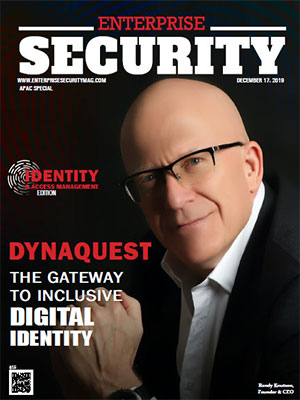
Dynaquest
The Gateway to Inclusive Digital Identity

 Randy Knutson, Founder & CEO
Knutson, the Founder and CEO of DynaQuest, is a veteran in the IT and BPO services space with 35 years of experience in catering to organizations ranging from startups to multinational companies as CIO and CTO. In his extensive career, Knutson noticed that a large segment of the global population is without legal identities, which essentially hinders a government’s efforts in connecting people to education, healthcare, and basic social services. As a result, the economic progress and the standard of living in such regions have taken a step back.
“In the Philippines alone, estimates range are between 14 million to 17 million people, without registered identities. And, without an established identity in the current economic setting, these people do not have the basic privileges to lead a healthy social life, all the while losing out on the full benefits offered by the government to the citizens of the Philippines. At DynaQuest, we aspire to help our economy and other geographies to establish a self-sovereign identity management portfolio through our technological competencies,” adds Knutson.
DynaQuest aims to help the UN achieve its sustainability goals of documenting the birth certificates of 1.1 billion people around the world by 2023, with identity serving as the pedestal for global and economic development. The company’s secret sauce in the identity management space is its proficiency in Blockchain technology.
The Identity Challenge
According to Knutson, the most challenging aspect of identity management is supporting the continuous maintenance of identity platforms around the world, despite the influx of organizations establishing identities in the Blockchain consensus. Underdeveloped or developing nations often lack a resilient identity management system, with aging databases that store the identity of individuals; such frameworks contrast the evolving applicability of open-ended identity management systems that are not only inclusive of value-added services but also flexible to technological changes in the disruptive digital age. With government organizations and e-commerce companies cashing in on such innovative technologies, the traditional methodology of preserving personally identifiable information (PII) in centralized ID databases has become antiquated. As a result, the necessity for homogenous identity management architecture dawns upon the technological realm.
The Identity Blockchain Solution
DynaQuest has developed a noteworthy, ‘inclusive’ methodology for information extraction, migration, and serialized development of identity and access management through a decentralized architecture. The company’s solution stack consists of layers of Blockchain architecture, ID framework, APIs, and ‘hosted protocols.’
Identities managed through this Blockchain architecture allow participants such as governments and solution providers to partake in identity verification functions, with the decentralized layers governing time-stamped updates and reconciliation of user information. Similarly, DynaQuest’s core Blockchain framework adds an overarching layer of digital identity services provisioned to the citizens. Non-profit organizations and solution providers need to go through this Blockchain framework to provide value-added services to citizens while accessing PII. On the other hand, user information is distributed across a decentralized network of data lakes and data centers.
On the end-user side of the spectrum, the decentralized self-sovereign identity framework enables users to update their credentials over a defined period of time. DynaQuest nurtures self-sovereignty through cryptography, reinforcing its capabilities to dodge phishing attacks and identity theft. With the resilience of this nature, Blockchain and digital identity function as the underlying layers of security for PII, thereby preserving information in a safe and incorruptible manner. The records would effectively be updated by trusted parties only, wherein all the changes are logged in a chronological record. The Blockchain Identity architecture eliminates the age-old hurdle of documenting ethnic minorities dwelling in rural areas— people that are often considered invisible in a national registry scale. It also addresses the formidable obstacle of identity duplication and siloed record-keeping practices, which hinder collaboration among various participants that are tasked to manage these identities.

DynaQuest has developed a noteworthy, ‘inclusive’ methodology for information extraction, migration, and serialized development of identity and access management through a decentralized architecture

On the end-user side of the spectrum, the decentralized self-sovereign identity framework enables users to update their credentials over a defined period of time. DynaQuest nurtures self-sovereignty through cryptography, reinforcing its capabilities to dodge phishing attacks and identity theft. With the resilience of this nature, Blockchain and digital identity function as the underlying layers of security for PII, thereby preserving information in a safe and incorruptible manner. The records would effectively be updated by trusted parties only, wherein all the changes are logged in a chronological record. The Blockchain Identity architecture eliminates the age-old hurdle of documenting ethnic minorities dwelling in rural areas— people that are often considered invisible in a national registry scale. It also addresses the formidable obstacle of identity duplication and siloed record-keeping practices, which hinder collaboration among various participants that are tasked to manage these identities.
The Merits of Digitalization
Government operations such as voting, access to healthcare, and education privileges can be orchestrated through the same network. Moreover, documenting PII over such a decentralized ledger upholds donation campaigns and aids mobilization initiatives. The traditional model of aid mobilization involved the donor sending support through monetary or consumable resources. Such an aid passes through logistics and verification before reaching the beneficiary, increasing the complexity and processing time. Often, these transactions are not recorded or documented correctly, leading to corruption and misuse of resources. On a decentralized ledger, however, every transaction goes through the time-stamped, consensus Blockchain network with logistics, asset allocation, and real-time asset tracking built into the core module. Also, Blockchain automatically authenticates transactions by shortening the verification time for seamless fund transfer. This function also applies to smart contracts and digital wallets, with beneficial bonds that would allow direct or peer-to-peer donations. Highlighting the merits of such noteworthy integrations, Knutson says, “A Blockchain network provides a multitude of benefits. While beneficiaries can receive aid at the hour of turmoil, service providers such as insurance companies can develop a distributed model for greater transparency.”
DynaQuest, through its decentralized model, is currently forging alliances with several non-profit organizations to establish a cooperative economy among indigenous farmers, partners, and suppliers, thereby deploying an ID stack architecture as the foundation upon which identity validation can be conducted. It is also partnering with the governments of various countries for the inclusive, sustainable, and economic prosperity of people in the developing regions. DynaQuest also performs quality assurance for the data collected across these regions during the enrolment of users, taking into account the logistics, equipment, and the on-field IT team required to streamline the process of service delivery for government organizations.
Building Self-Sovereignty: The Indigenous Initiative
One of the several meritorious projects taken up by DynaQuest is the Identities for the Indigenous Initiative that aims to identify, enroll, and develop the many underserved Indigenous communities in the Philippines, by helping its people through an inclusive economy built around digital identities and Blockchain technology. The country is rich in natural resources, minerals, and agricultural assets such as abaca and coconut and many of these promising resources are under the Indigenous ancestral domains that were classified by the government as a bestowal of their economical identity. Furthermore, the many ancestral lands can be a hotbed for agricultural tourism that can generate economic partnerships through trade and exports. DynaQuest’s initiative of digitalizing the economy of these regions spans five phases with the initial rollout of digital identity systems, followed by the gathering of PII through Blockchain-powered digital identity validation. By coordinating with government and international agencies for a multi-sectoral development plan, DynaQuest oversees the inclusion of production and supply chain infrastructures on the decentralized economy model. Thereafter, value-based services and cooperative programs would boost the Blockchain-powered economy for the overall development of these regions. The initiative is aimed at preventing illicit activities such as conflict mining, slavery, child labor, and human rights violations. Collectively, the project promises to build an inclusive economy that is not only self-sovereign but also in alignment with digitalization.
"We aspire to help the economies of such geographies establish a self-sovereign identity management portfolio through our technological competencies"
The road taken by DynaQuest nurtures an inclusive digital economy, and it is a no-brainer that the company’s aspirations to catalyze a Blockchain-driven economy are close to fruition. It is the amalgamation of Blockchain, IoT, and FinTech technologies that has empowered DynaQuest to efficiently cash in on opportunities created by digital disruption witnessed in the current day and age. The company has initiated a 45-day Blockchain transformation program quite recently to deliver a cost-effective, fully-operational Blockchain-enabled system based on decentralized technology. In this program, DynaQuest understands a business, corresponding operations, and the technology already in use, all the while engaging with clients to fulfill various business requirements. It then maps the relevant processes with business use cases under the Blockchain consensus for the initial prototyping phase. All of these processes are supported from an analytical standpoint for consistent upgrades of the technological infrastructure through the course of the program.
“We will be going much further with our Blockchain pilot and engineering programs as a full-scale expansion in an effort to design, maintain, and participate in a decentralized inclusive economy,” concludes Knutson.
December 14, 2019

Company
Dynaquest
Management
Randy Knutson, Founder & CEO
Description
DynaQuest helps businesses transform from their existing systems to blockchain-enabled business information systems. The company aims to assist the UN achieve its sustainability goals of documenting the birth certificates of 1.1 billion people around the world by 2023, with identity serving as the pedestal for global and economic development. DynaQuest has developed a noteworthy, ‘inclusive’ methodology for information extraction, migration, and serialized development of identity and access management through a decentralized architecture. Identities managed through this Blockchain architecture allow participants such as governments and solution providers to partake in identity verification functions, with the decentralized layers governing time-stamped updates and reconciliation of user information