THANK YOU FOR SUBSCRIBING
× 
Enterprise Security Mag Weekly Brief
Be first to read the latest tech news, Industry Leader's Insights, and CIO interviews of medium and large enterprises exclusively from Enterprise Security Mag
Enterprise Security Magazine

CHT Security
Where Deep AI Contextual Attack Intelligence Builds Operational Resilience

How are enterprises balancing AI adoption with the need to secure AI-driven environments?
CHT Security has framed its direction around a two-sided reality now shaping enterprise risk: empowering cybersecurity with AI and safeguarding AI with cybersecurity.
AI is moving deeper into enterprise operations and security teams now protect more than networks, endpoints and cloud infrastructure. They must also secure AI applications themselves, where model behavior, data exposure, misconfiguration and misuse create risks that traditional controls were not built to address.
 CHT Security delivers dedicated protections for enterprise AI environments through AI Application Security Testing and AI Security Diagnostics, alongside AI-enabled SOC services. These services cover security validation, diagnostics, continuous protection, monitoring and incident response for AI applications in active business deployment.
The work is no longer theoretical. CHT Security has deployed these services for financial institutions and high-tech companies, building operational experience in environments where AI adoption must be matched by security discipline from the start.
That direction extends from a broader SOC model built around monitoring across diverse client environments. Decision quality under pressure requires more than prompt alerts. It requires context, traceability and a shared understanding of how attacks unfold.
How does contextual threat intelligence improve detection accuracy and response quality?
The SOC operates within an ISP environment through its parent company, Chunghwa Telecom, giving it access to cross-border threat intelligence on malware activity and attack patterns. Carrier-grade visibility enables earlier threat identification and gives analysts more context when investigating suspicious behavior. Signals feed forensic and reverse-engineering work as patterns begin to form. Analysts can act earlier, before incidents escalate.
Analysts move findings into retrospective analysis, tracing related activity within retained logs and monitored environments, subject to customer telemetry and retention policies. They reintegrate newly confirmed indicators and refined detection logic into SOC monitoring workflows, shortening time to recognition when similar tactics reappear.
To maintain consistent analysis under load, the SOC maps all activity to the MITRE ATT&CK framework, tying each event to known adversary tactics and techniques. Analysts across shifts assess incidents using the same reference points, cutting interpretation variance.
"Our analysts are not measured by the sheer volume of alerts closed," says Jerry Wang, CTO and VP, "We measure them by their ability to disrupt the attack lifecycle. When you possess deep visibility into the adversary's next move, informed speed becomes a catalyst for resilience, rather than an accuracy risk."
CHT Security has incorporated AI Agents into its SOC for threat analysis and automated response, cutting identification and response times. It collaborates with leading international cybersecurity vendors to broaden defense coverage across customer environments. AI adds speed and scale within a workflow built to keep analysis reviewable and response decisions traceable.
From Detection to Containment: One Workflow, Many Signals
What operational model enables rapid containment across diverse security signals?
CHT Security structures SOC work as an execution chain. Telemetry from cloud platforms, network infrastructure, endpoints and exposure surfaces flows into a unified operating view. MDR agents add behavioral precision at the endpoint level, allowing suspicious activity to be validated closer to its origin rather than inferred after escalation.
SOAR provides response execution. Custom playbooks coordinate actions across security devices to automate alert validation, incident confirmation and containment steps. When threats are confirmed, response actions can trigger immediate controls, including the distribution of malicious IP and command-and-control blocklists to client firewalls with integrations in place. Containment shifts from hours to minutes, limiting the spread before incidents mature.
Depth remains essential. MDR tooling supports remote investigation of intrusion paths and affected scope, allowing teams to validate intent, assess impact and guide remediation without waiting for on-site intervention. A single, internal case-management view tracks status, actions taken, evidence and outcomes, reducing handoff risk and keeping response steps coherent.

Our analysts are not measured by the sheer volume of alerts closed. We measure them by their ability to disrupt the attack lifecycle. When you possess deep visibility into the adversary's next move, informed speed becomes a catalyst for resilience, rather than an accuracy risk.

Depth remains essential. MDR tooling supports remote investigation of intrusion paths and affected scope, allowing teams to validate intent, assess impact and guide remediation without waiting for on-site intervention. A single, internal case-management view tracks status, actions taken, evidence and outcomes, reducing handoff risk and keeping response steps coherent.
Consistency Across IT and OT Environments
How does CHT Security maintain consistent security operations across IT and operational technology environments?
Operations become more complex when IT and operational technology converge. Availability expectations differ. Protocols behave differently. Controls that work in enterprise IT can disrupt industrial systems if applied without context.
CHT Security addresses this through alignment rather than force-fitting. OT monitoring relies on methods designed to preserve operational stability, including passive monitoring and protocol-aware analysis. Industrial control systems and OT assets are monitored by deploying OT-IDS capabilities that detect physical isolation breaches, abnormal behavior and communication anomalies without interrupting production.
OT SOC services follow the incident lifecycle. Pre-incident work focuses on Purdue Model analysis, deployment planning and asset visibility. During incidents, 24/7 monitoring correlates alerts across OT security devices using parameters tuned to operational constraints. Post-incident work validates events and delivers remediation guidance designed for industrial environments.
A standardized core process supports both IT and OT operations while allowing detection models and thresholds to be tuned by context. Unified incident classification, threat scenario modeling and response playbooks maintain consistent quality across architectures.
SRM as a Governance Layer
What role does governance play in maintaining traceability and decision consistency in SOC operations?
Consistency requires more than tools. It requires governance that keeps analysis, decisions and approvals traceable.
CHT Security’s SOC operates a proprietary Security Risk Management (SRM) platform that systematizes incident workflows. SOC and MDR alerts are aggregated into a single interface, so Level 1 and Level 2 analysts and client teams can collaborate without losing context across tools. Standard operating procedures run through the system. Notifications align with impact levels and SLA thresholds. Investigation records follow structured formats and audit trails capture actions from alert creation through containment and closure.
Dashboards extend transparency outward. Monitoring status and response progress update in real time, supporting shift handovers and management oversight. Clients experience fewer gaps between teams, more consistent timelines and decisions supported by traceable reasoning rather than informal interpretation.
Closing the Loop After an Incident
How does post-incident analysis improve long-term security resilience?
Managed security becomes credible when services improve after every incident.
CHT Security runs post-incident reviews using SRM audit trails to evaluate detection effectiveness, response timing against SLA milestones and decision quality across analyst actions and recommendations. Findings translate into operational changes. Log collection expands where visibility gaps appear. Detection logic updates as new indicators and observed tactics emerge, fine-tuning thresholds to reduce false positives and improve precision. Playbooks change when investigations reveal bottlenecks. Client-side hardening guidance addresses configuration exposure, patch gaps and weak controls that allowed intrusion paths to form.
This feedback loop keeps service aligned with live adversary behavior rather than static assumptions.
A Case in Financial Security Governance
Mega International Commercial Bank’s story illustrates how SOC operations and SRM governance combine in a co-managed model.
Mega Bank launched its SOC program in 2017 and began collaborating with CHT Security in 2020. Joint development work produced a threat management system that evolved into today’s SRM platform, creating an integrated framework spanning monitoring, incident handling and emergency response. SOC execution paired with SRM governance supports real-time risk alerting and faster internal coordination. Ongoing maturity assessments aligned with third-party standards keep governance current.
Scaling Across Asia with a Broader Platform
How is CHT Security expanding its capabilities to address evolving cybersecurity challenges?
CHT Security’s roadmap targets areas where operational complexity rises fastest, including cloud security and OT cybersecurity. Investment continues in AI-driven capabilities such as de-obfuscation analysis, intelligent monitoring and AI assistants designed to support analysts without replacing judgment.
Product development complements managed services. Offerings include SecuTex NP for detecting network and IoT compromise, SecuTex ED for malware forensics and threat intelligence and HorusEyes for data leakage intelligence, phishing detection and AI-assisted impersonation threats.
For enterprises and institutions, the outcome is confidence that SOC decisions reflect the attack lifecycle, that response quality remains consistent across shifts and environments and that risk management is always deliberate under pressure.
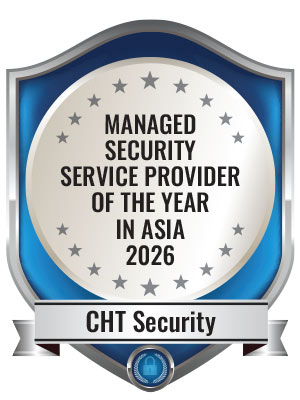
This is the mark of managed security at its highest level; not faster alerts, but better decisions under pressure. That is why CHT Security has been recognized as Enterprise Security Magazine APAC’s Managed Security Service Provider of the Year in Asia 2026.
The recognition reflects how the company builds resilience through structured responses and decision stability, where clarity comes first and speed follows.
Asia's Benchmark for Managed Security Services
Cybersecurity leaders across Asia face a threat environment defined by scale, velocity and growing asymmetry between attackers and defenders. Distributed cloud adoption, hybrid IT estates and the convergence of information technology and operational technology have expanded attack surfaces faster than internal teams can reasonably govern. In this climate, outsourcing security oversight is no longer about coverage volume. Executive buyers increasingly prioritize the consistency of detection, the speed of response and the ability to turn incidents into long-term risk reduction rather than recurring disruption.
Managed security services in the region vary widely in maturity. Some providers emphasize tool aggregation; others rely solely on human monitoring. What distinguishes stronger models is the degree to which monitoring, investigation and response operate as a single system rather than disconnected functions. Effective services combine deep threat intelligence, disciplined response workflows and automation that support analysts rather than replacing judgment. They also adapt to environments where availability constraints, regulatory oversight and legacy infrastructure limit the applicability of standard controls.
Against this backdrop, a credible managed security partner must demonstrate three qualities in practice rather than in its messaging. Detection must be informed by current adversary behavior across borders, not static signatures. Response must be predictable and repeatable regardless of time zone or client complexity. Improvement must be systematic, using real incidents to refine future defenses rather than treating resolution as an endpoint.
CHT Security reflects these attributes through an integrated service model that unifies SOC operations, MDR and SOAR-enabled automation within a single operating framework. Its security operations center draws on ISP-grade, cross-border threat intelligence to analyze emerging attack techniques, using the MITRE ATT&CK framework to map adversary tactics and stages across intrusion. This approach improves alert quality by anchoring detection logic in how attacks unfold rather than isolated indicators.
Response discipline is reinforced through tightly structured workflows supported by its proprietary Security Risk Management (SRM) platform. Alerts, investigations and remediation steps are handled within a unified environment that preserves audit trails and shortens escalation paths. Automation is applied selectively through SOAR playbooks that validate alerts, push threat intelligence into enforcement controls and block malicious IPs and command-and-control infrastructure at client firewalls while keeping analysts in control of decision-making. The result is faster resolution without introducing unmanaged risk.
A further differentiator lies in CHT Security’s ability to operate across both enterprise IT and sensitive industrial environments. Industrial systems demand passive monitoring, protocol awareness and strict protection of availability. By applying customized detection models on top of standardized response processes, the service maintains consistent quality across architectures that are rarely addressed effectively by conventional providers. For OT/ICS environments, CHT Security highlights OT-focused detection, such as OT-IDS, plus Purdue Model analysis and planning support, advisory capabilities around industrial security standards, including IEC 62443, that reinforce this depth without overextending into consultancy-led abstraction.
Equally important is how learning feeds back into service delivery. Incident reviews are embedded into operations, with detection rules, log coverage and response playbooks adjusted based on observed gaps. CHT Security describes post-incident review using SRM audit trails, including expanded log collection, detection rule and threshold tuning, playbook refinement and client-side hardening recommendations. This creates a steady progression from reactive defense to informed prevention, reducing repeat exposure over time. For executive stakeholders, this continuity translates into fewer surprises, clearer reporting and greater confidence during transformation initiatives such as cloud migration or regional expansion.
For organizations evaluating managed security services in Asia, the strongest offerings are those that behave less like outsourced monitoring desks and more like disciplined security partners. The emphasis should fall on intelligence-backed detection, systematized response and measurable improvement grounded in operational reality.
Within this landscape, CHT Security stands out as the provider that most consistently embodies these principles. Its integrated SOC + MDR + SOAR model, supported by proprietary systems and experience across critical sectors, positions it as the reference choice for enterprises seeking sustained, dependable security oversight rather than episodic intervention.
...Read more
Company
CHT Security
Management
Jerry Wang, CTO and VP
Description
CHT Security is a subsidiary of Chunghwa Telecom delivering managed security services across IT and OT environments. Through continuous SOC monitoring, threat intelligence, MDR, SOAR automation and its proprietary SRM governance platform, it enables consistent incident response, operational resilience and decision clarity under pressure.