
THANK YOU FOR SUBSCRIBING
× 
Enterprise Security Mag Weekly Brief
Be first to read the latest tech news, Industry Leader's Insights, and CIO interviews of medium and large enterprises exclusively from Enterprise Security Mag
Enterprise Security Magazine: Specials Magazine
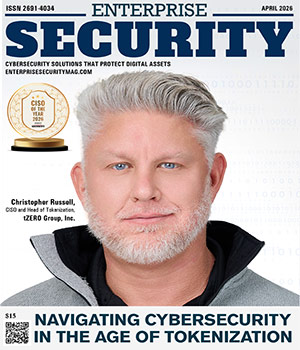
Christopher Russell, the Chief Information Security Officer (CISO) and Head of Tokenization at tZERO Group, Inc., is a seasoned cybersecurity expert with extensive experience in the ever-evolving world of information security. With a strong background in enterprise risk management, incident response, and application security, Russell has been at the forefront of integrating security measures into the fabric of tZERO’s innovative blockchain-based services. His expertise lies not only in traditional cybersecurity but also in ensuring that cutting-edge technologies like tokenization and smart contracts are secure from the ground up. Before joining tZERO, Russell held various senior security roles, where he honed his skills in creating resilient and proactive security infrastructures for technology-driven businesses. His journey has been marked by a commitment to continuous learning and adaptation in a world where cyber threats evolve at an alarming pace. Today, as CISO and Head of Tokenization, he leads a team that ensures tZERO’s technology stack remains secure while supporting the company’s growth in tokenization and blockchain technology. BUILDING SECURITY INTO THE PRODUCTS At tZERO, my role as CISO and Head of Tokenization encompasses a diverse set of responsibilities that combine traditional security measures with emerging technologies. My primary responsibilities include overseeing enterprise risk management, application security, vulnerability management, endpoint detection and response, and incident response. These form the foundation of our security posture, ensuring that we maintain a resilient environment against ever-evolving threats.
Digital Magazine
Data Security
Why do legacy SIEM architectures fail under modern telemetry scale and complexity? Enterprise security is only as strong as the breadth and integrity of the data it preserves. As cloud use expands, operational technology environments remain critical, and AI adoption introduces new operational layers; telemetry volumes have grown beyond what legacy tools and architectures were designed to handle. Many traditional security information and event management (SIEM) platforms were built as analytics engines first and databases second—if at all. That design worked when data volumes were manageable; 500 gigabytes used to be considered ‘big data.’ Now, organizations are creating terabytes to petabytes of data every day. Despite leaps and bounds in security technology, legacy SIEMs and log management tools struggle to store such massive quantities of raw telemetry for extended periods while needing to maintain search performance and cost predictability. Gravwell was built from the outset to address that structural limitation, posing the question, “What would a SIEM look like if built from scratch with the lessons learned over the past decade?” Positioned as a security data platform (SDP) rather than just a SIEM or detection engine, Gravwell is a time-series data lake with SIEM capabilities and analytics built on top, separating the function of storing ground-truth telemetry from the tools that analyze it to enable organizations to economically ingest and store all their data in full fidelity. At the core of Gravwell’s architecture is a structure-on-query model. Instead of normalizing logs before ingestion, the platform preserves raw records, including binary data, NetFlow, full packet capture and even malformed logs, exactly as received. This model only applies structure at query time, enabling organizations to ingest data types that legacy SIEMs can’t because they parse data on ingest and force it into rigid schemas. This results in dropped data and blind spots across the organization where threats can go undetected..

Physical Security

It is just before dawn when activity appears inside a distribution facility that should be empty. A side entrance opens and a vehicle remains longer than expected, but no alarms sound. Inside the control room, the system flags the event. Video from the entry security camera appears alongside access credentials and recent movement patterns. The person on site is authorized. The vehicle belongs to a contracted carrier arriving ahead of schedule. No escalation follows and operations continue without interruption. This is not security reacting to a threat. It is a system designed to present correlated information—video, access data and activity history—so operators can quickly distinguish between incidents that require intervention and routine activity that simply needs documentation. Salient Systems builds video management systems (VMS) for moments like this. Its enterprise platform brings video, system data and integrations into a single operational view, supporting security, operations and business insight across on-premises, cloud and hybrid environments without disrupting operations. “We’re not in the business of creating alert fatigue,” says Stacey Steiger, VP of product. “Our goal is situational awareness that helps organizations respond with intent, acting decisively when needed and staying out of the way when it’s not.”
Physical Security
Every shift at American Global Security (AGS) follows a disciplined rhythm. Professionally trained, site-assigned guards show up on time, follow strict protocols, operate under careful supervision and provide real-time reporting. “We don’t sell security, we make reliability measurable,” says Sulaiman Wardak, regional vice president. AGS’s growth is a reflection of trust earned, not marketed. For the last 45 years, the Los Angeles-based company has been creating a security system that is accountable, consistent and built for follow-through. It has over 800 trained security professionals deployed across dozens of sites. Site-Specific Security Strategies How are security strategies adapted to different industry environments and specific operational needs? AGS does more than simply placing guards on-site. It carefully evaluates the unique threat potential of each environment and creates staffing structures that fit those needs. It recognized early on that uniform protection models are ineffective across different industries. In environments where emotional volatility runs high, such as healthcare facilities, AGS’s security guards prioritize communication and de-escalation over physical force. Hospitals operate around the clock under constant pressure, stress and urgency. In this setting, the guards are trained to manage heightened emotions, prevent disputes and ensure medical teams can work without interruption.

Identity and Access Management

How does Allstate Identity Protection address the growing complexity of AI-driven identity fraud? The defining story of Allstate Identity Protection is not simply the tools it provides. It is trust. The company brings 18 years of experience in identity protection, backed by a brand with more than 90 years of protecting consumers. That history has shaped an approach rooted in reliability, accountability and a long-term commitment to the people it serves. Experience at this scale becomes even more relevant as threats grow more complex. Identity theft is no longer an isolated financial inconvenience: It has evolved into an AI-fueled ecosystem of scams that cut across age groups, income levels and digital behaviors. Fraudsters now exploit urgency, impersonation and massive volumes of exposed personal data to pressure victims into action before they can verify what is real. Allstate Identity Protection addresses this environment with a holistic, end-to-end model structured across three layers: prevention, detection and restoration. Rather than offering a single alert or standalone tool, it integrates preventive tools, multi-point monitoring and dedicated restoration support into one coordinated system. “We are built on trust, and that trust gives consumers confidence that we will stay with them from the first sign of fraud, all the way through restoration,” says Binsy Geevarghese, chief product officer.
Biometric & Access Control

Keys to Reaching The Peak of A Cyber Security Program Journey
Christine Vanderpool, VP IT Security & CISO , Florida Crystals
Threat Intelligence
Physical Security in the Age of Technology & AI
Casper Eloff, Head of Corporate Security, The Mosaic Company
Saas Data Protection

A Modern Data Strategy for a Connected World
Dr. Yingying Kang, Director of AI & Data Science, Assurant
Blockchain

Balancing Risk and Agility in a Changing Cyber Landscape
Brian Weidner, Chief Information Security Officer, A. O. Smith Corporation
Data Security

IoT Analytics Enablement with Data Naming Standardization
Darin McCoy, Senior Manager, and Andrei Khurshudov, Director, IoT Analytics and AI, Caterpillar Inc

IN MY OPINION
Vulnerability Management
Maturity of Vulnerability Management in Securing an Organization's IT Assets
Nichole Bray, Director of Vulnerability Management, Global Tech Information Security, Walmart
LAST WORD
Risk and Compliance Management
Keeping it REAL with Your Security Vendors
Robert Pace, Vice President Information Security | CISO, Invitation Homes
IN FOCUS
Maximizing Safety and Efficiency: Current Trends in Video Monitoring Systems
Video surveillance platforms enable intelligent monitoring, scalable security operations, integrated analytics, and coordinated public and enterprise safety.
Advanced Security Platforms: Aligning Technology with Enterprise Goals
Advanced security data platforms are evolving to unify visibility, adapt to dynamic threats, and align security strategies with broader enterprise resilience and growth.
EDITORIAL
Building Resilient Enterprise Security Systems
Security strategy is entering a phase defined less by tools and more by disciplined architecture, operational visibility and coordinated response. As enterprises expand digital infrastructure and manage increasingly complex physical environments, Enterprise Security Magazine examines the technologies and operational models shaping enterprise protection in 2026.
Our cover story recognizes Christopher Russell, CISO and Head of Tokenization at tZERO as the CISO of the Year 2026. With a strong background in enterprise risk management, incident response, and application security, Russell has been at the forefront of integrating security measures into the fabric of tZERO’s innovative blockchain based services.
At the center of this issue is Gravwell, recognized as the Advanced Security Data Platform of the Year 2026. The company distinguishes itself by addressing a fundamental challenge in modern security, managing and preserving massive volumes of telemetry without loss or compromise. Built as a security data platform rather than a traditional SIEM, Gravwell enables organizations to ingest and retain data in full fidelity using a structure on query approach. By separating data storage from analytics, it ensures continuity, scalability, and investigative depth while maintaining predictable cost structures. This architecture allows enterprises to preserve ground truth data, eliminate blind spots, and sustain performance across cloud, on premises, and hybrid environments.
This issue also recognizes organizations advancing security from complementary perspectives. Salient Systems, awarded Video Surveillance Platform of the Year 2026, has established itself as a key provider of scalable video management solutions that enhance situational awareness across enterprise environments. Its platform allows organizations to transform video infrastructure into a reliable operational intelligence layer. Meanwhile, American Global Security, named Top Security Guard Services 2026, highlights the continuing importance of highly trained personnel in modern security strategies, delivering structured guard services that integrate physical presence with broader enterprise security frameworks.
Beyond technology and services, leadership insight remains essential. In this edition’s CXO perspectives, Nichole Bray, Sr Director of Information Security, Vulnerability Management at Walmart, and Christine Vanderpool, VP & Chief Technology Officer at Florida Crystals share practical viewpoints on vulnerability governance, risk prioritization, and the operational discipline required to manage security at scale.
Together, these perspectives illustrate a clear direction for enterprise security. Success depends on integrating technology, operational rigor, and informed leadership. We invite readers to explore the insights presented throughout this issue and engage with the strategies shaping the next phase of enterprise protection.
